
Concept · work in progress · v0.0.21 · 9 September 2026
What we are building, and why.
Most virtual airline software is built for one pilot at a time: you pick a flight, you fly it, you file it, and nothing you did touches anyone else. Some of it is excellent at exactly that, and a few platforms do it well for a group flying together. What we have not found anywhere is an airline where the pilots are connected to each other organically — where your arrival is the reason someone else's departure goes out full; where a late feeder, a freighter stuck at an outstation or a holiday surge is a dynamic event the whole airline lives through together; and where the consequences are shared rather than logged. Slavic Airlines Group is being built for the pilot who wants to be part of a line: a live group of people working together the way a real airline's crews do, not a logbook with a livery on it.
This page is the plain statement of that intent — what exists today, what is designed but not built, what it takes to fly with us, and what we are asking the companies whose tools we depend on. It will change as we learn, and it will change faster when you tell us what to fix.
The idea in one paragraph
None of this needs inventing from scratch. The developers around Microsoft Flight Simulator 2024 have already built the pieces: vAMSYS keeps the records and provides the ACARS client, SimBrief makes the plan, GSX runs the ramp, Hoppie and SayIntentions carry the datalink and put voices on the radio, and the study-level aircraft bring their own EFBs and cockpit printers. What has been missing is the thread that runs through all of them. Our job is that thread — bringing every integration we can find together so that, from the moment you claim a line to the moment you set the brake on the last sector, you are living a real line pilot's day as fully as the tools allow. With the vendor support that exists today we think that is most of the way there, and we would rather use each product the way its makers designed it than work around any of them.
What we are trying to achieve
You are part of a line
The aircraft you deliver is the one another pilot takes out; the feeder you bring in is what fills the next departure. Pilot to pilot, with consequences — that is the whole point.
No window-bouncing
One claim creates every sector's booking in vAMSYS, in order; the ACARS client always finds the next flight waiting.
Numbers with consequences
Final passengers, bags, cargo and zero-fuel weight are computed from a hidden economy and real dependencies, delivered to the cockpit by ACARS, and loaded by GSX and the aircraft EFB from one SimBrief plan.
It remembers
Aircraft stay where they are parked; a missed connection costs the airline; every PIREP updates the world.
Vendors' products used as designed
vAMSYS keeps the records, SimBrief carries the plan, GSX runs the ramp, Hoppie and SayIntentions carry the datalink — our platform only adds the glue and the consequences.
Later, the whole ledger
Fuel, route charges, ground-handling costs, revenue from the loads — a ledger the airline lives by.
Built from the base game up
You do not need a shelf of add-ons to fly the line. Everything on the airline side — the line you claim, the bookings, the briefing, the final loadsheet, the connections you protect or miss and what that does to the airline — is the same whether you own the base game only or every study-level aircraft on the market. What the add-ons change is how much of it reaches you inside the cockpit instead of on this site or your phone. Each one you add lights up more of the diagram further down. None of them will ever be a condition of flying with us.
| What you have | What it gives you |
|---|---|
| Microsoft Flight Simulator 2024 and a free vAMSYS pilot account | The whole airline. You claim a line, fly it in the closest aircraft your simulator has to the type we planned, Pegasus files each sector, your loadsheet and your next booking are waiting on this site and on your phone, and the network remembers what you did. |
| + SimBrief (free) | Your plan arrives pre-filled with the final passengers, cargo and zero-fuel weight. One click to generate; your aircraft's EFB imports it. |
| + a study-level aircraft | Real cabin and cargo layouts, an EFB that loads the plan, and — on aircraft with a datalink — the loadsheet on the cockpit printer. |
| + GSX Pro | The ramp boards, loads and fuels to the same numbers as your loadsheet, and pushes when the loadsheet says you are ready. |
| + SayIntentions, Hoppie (free), VATSIM or IVAO | PDC and CPDLC, a dispatcher and cabin crew who know your flight, and company messages by ACARS on whichever network your aircraft speaks. |
When the day does not go to plan
What happens after that is ours. A diversion or a late arrival is not a note in a logbook; it ripples through the airline. The connecting passengers on your aircraft miss their bank at Warsaw and are rebooked — or are not, and the revenue goes with them. The aircraft is now at the wrong airport, so the pilot who was meant to take it out at 06:10 tomorrow has no aircraft and the schedule has to recover. The ground-handling bill at the diversion airport lands in the ledger. Your own next sector's loadsheet is lighter, or later, or flown by someone else. You will see all of it on the Ops board the moment you land — and so will everyone else on the line. The ripple is the point. It is what makes a line feel like a line.
The more of us who fly, the richer it gets
Where there is no one at the other end yet, our Virtual Pilots fly. They are the automated fleet that keeps every sector of the timetable moving around the clock, so a connection always exists, an aircraft is always where the schedule says it is, and a late arrival always has someone waiting for it. They fill the gaps between us so the airline feels whole — one operation, the way a real airline's is — and they step aside the moment a Command Pilot claims the line. Nothing about the world changes when a Virtual Pilot flies a sector: the same loads, the same consequences, the same ledger. Every Command Pilot who joins replaces one more of them with a person.
How we are building it — the method
The structure we are moving to
Slavic Airlines — hub and spoke
Banks of departures and arrivals at Warsaw (EPWA). Connections are the product; this is where "the network remembers" lives.
Slavic Air Express — point to point
Aircraft and crews live at bases and fly out-and-back and W-patterns. No connections to protect — but the aircraft is where you parked it, and on-time is on-time.
Slavic Airlines Cargo — a blend of both
A night feeder bank into the cargo hub plus scheduled trunks between gateways. Tonnes at risk instead of passengers.
The mergers on the About page — Polania, Lechistan, Wendish Skies and the rest — are the lore that explains our size; the operating structure above is what the schedule will actually be built on. Both are deliberate, and both are told openly.
One sector, end to end
| When | What happens |
|---|---|
| T−30 days | You claim a line on this site. Our backend creates the vAMSYS booking for each sector, in order, with the planned passengers and cargo, flight number and callsign. |
| T−24 h | Planned loadsheet and briefing on your EFB page; the dispatcher and cabin crew personas in SayIntentions are told about your flight. |
| T−60 min | Weather, feeder status and a pre-filled SimBrief plan are waiting for you. |
| T−15 min | The FINAL loadsheet — actual loads minus missed connections, capped by the cabin, checked against the weights — is sent by ACARS. You press Generate once on the pre-filled plan; the plan is attached to your booking. |
| T−12 min | Your aircraft imports the plan; GSX boards to the same passengers and cargo and sets the fuel. |
| Pushback | Pegasus already holds the booking. PDC and CPDLC work where your aircraft and network support them, because the booking carried the exact callsign. |
| On blocks | The PIREP comes in. Connections are made or missed, the aircraft is parked where you left it, the ledger moves — and your next sector is already the oldest booking waiting. |
How the pieces connect
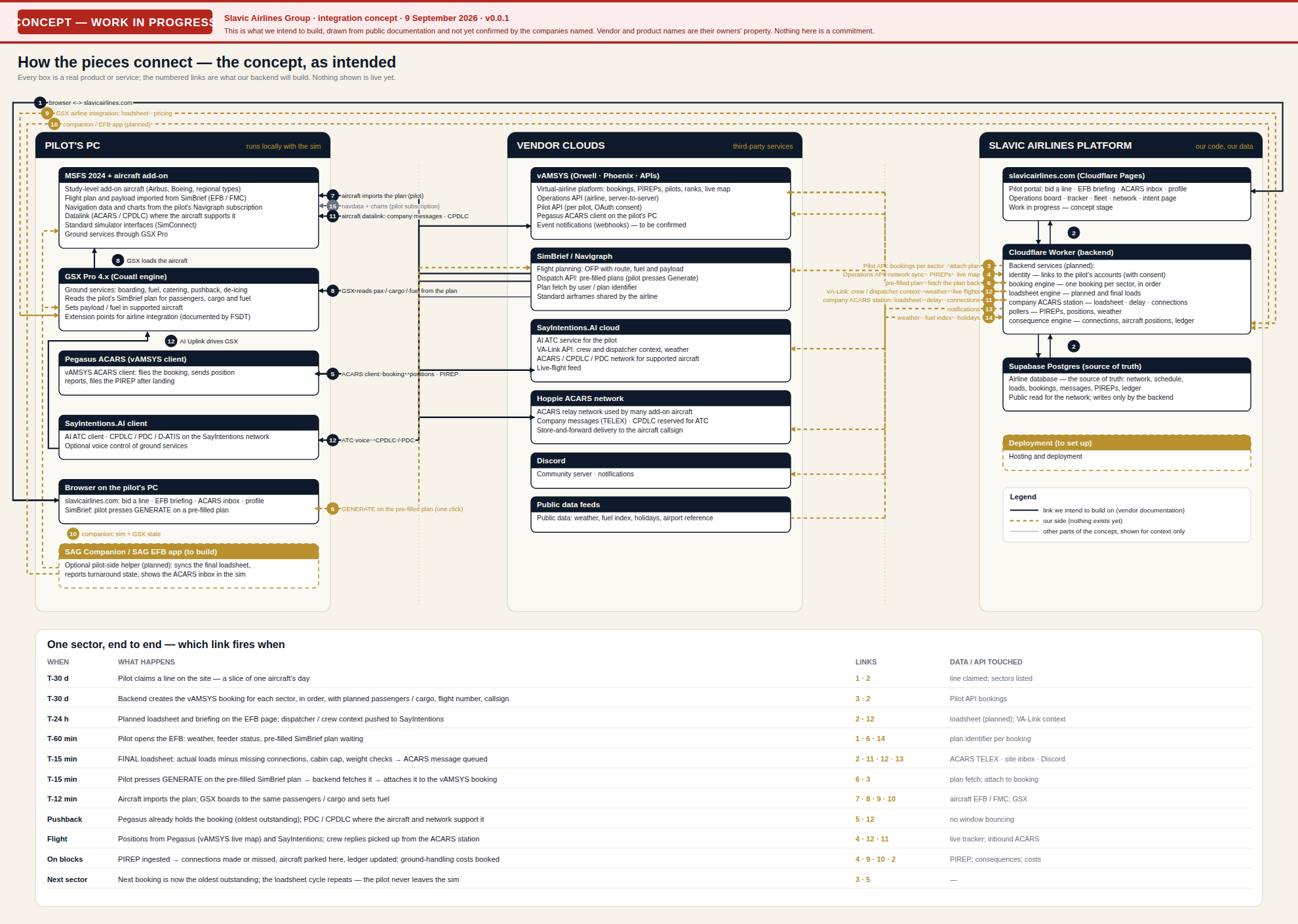
Concept diagram — the pilot's PC on the left, third-party services in the middle, our platform on the right; the numbered links are what our backend will build. Drawn from public documentation; nothing is live; vendor and product names are their owners' property. Click to open full size.
Where we are, and where this goes
We are very much in the conceptual phase, and the road out of it runs through the community. Very little of this is fixed: we are evolving the concept as we go, to whatever best serves the vision of a working line, and a section of this page can and will be rewritten when a better idea arrives.
Concept
What exists: the airport suitability study (709 airports with scenery, real runway data), the study-level fleet register, the surge calendar, a generated Q4 2026 schedule with connections and hidden actual loads, the bid marketplace you can browse, and the database and backend behind it. What is happening: moving from the vAMSYS trial to a subscription, briefs out to every vendor, foundations v2 (time zones, weights, event hosting). Nothing flies yet.
Alpha — a very limited community
A small group of volunteers flies real lines end to end on a conservative Europe-only proof of concept: one hub, two bases, one night cargo bank, about 35 aircraft. We fix what breaks, together. We will ask for volunteers on Discord when the first line can be claimed.
Beta — hopefully Q1 2027
Registration opens in waves. The economy ledger runs, the final loadsheet reaches the aircraft that can print it, and regions are added as the community grows into them.
Execution — hopefully the second half of 2027
The airline as intended: three groups, a living network, the economy, the company ACARS station. When it happens depends entirely on how the community grows.
Version numbers and milestones
We are nowhere near a 1.0, and the version in the footer says so. The number follows a simple ladder: the middle digit is the phase, the last digit ticks with every published change, so you can always tell how much has moved since you last looked. The milestones are the conditions for stepping up a rung — not dates, because the dates depend on the community.
| Version | Phase | What it means | What moves us to the next rung |
|---|---|---|---|
| 0.0.x | Concept | What you are reading. Design documents, this site, the vendor briefs. Nothing flies. Every revision of the site or a foundation document ticks the last digit. | vAMSYS subscription live · a claimed line creates its own bookings through the API · the first final loadsheet arrives by ACARS · the Europe proof-of-concept schedule is loaded |
| 0.1.x | Alpha | A very small volunteer group flies real lines end to end on the Europe proof of concept. Expect things to break; expect us to fix them with you. | Volunteers fly lines end to end without manual fixes · the vendors' answers are folded in · the loadsheet path works on the base game and on at least one datalink aircraft · GSX boards to the loadsheet |
| 0.2.x | Beta | Registration opens in waves (hopefully Q1 2027). The economy ledger runs. Regions are added as pilots arrive to fly them. | The network is stable through a full surge event · the ledger balances · the community is large enough that Command Pilots, not Virtual Pilots, carry the core banks |
| 0.3 – 0.9 | Expansion | Reserved for the steps between beta and execution: new regions, the companion app, the company ACARS station on the datalink networks, the cargo group at full strength. | Each rung has its own exit condition, published here when it is set |
| 1.0.0 | Execution | The airline as intended (hopefully the second half of 2027): three groups, a living network, the economy, and a crew room full of people. | — |
Current: v0.0.21 · concept · updated 18 September 2026. Changes are listed in the changelog inside every release of the site.
For vendors and partners
If you make one of the tools we depend on
The open questions, in short: vAMSYS — event webhooks, updating a booking after creation, callsign parameters for our sub-brands. SimBrief / Navigraph — an API key for pre-filled plans and whether server-side generation is available to airlines. SayIntentions — a company ACARS station on your network, where in-cockpit messages appear, event webhooks. Hoppie — one station across network affiliations and message length. PMDG, Fenix, iniBuilds, Just Flight, Synaptic, Leonardo, Aerosoft — whether a company message can be shown in the cockpit, the supported way to load passengers and cargo, and cabin presets per livery. FSDreamTeam — handler-script and Remote API details for our GSX integration. Microsoft / Asobo — what a tablet app may connect to.
Not exactly a real airline — on purpose
With thanks — and an apology in advance
And if someone out there is already working on something of the same nature, or if we simply missed it while digging through all of this, we apologise in advance — and we would like to hear from you. We are one person trying to glue all of these pieces together so that they fit each other; we would much rather join hands than duplicate work.
Built by one person so far — come and build it with us
How you shape it
We are building this in the open because we want guidance, not applause
Tell us what is confusing. Tell us what took too many clicks. Tell us what a real line pilot would laugh at. Tell us which aircraft and add-ons you fly with that we have not thought about, and which routes and rotations you want to see on the bid board. Tell us when a consequence feels unfair, and when it feels earned. We will not get all of it right the first time; we will get it right faster with you.
Discord is where decisions get made → or write to ops@slavicairlines.com. Answers to what the community raises are folded back into this page.
Provenance rule: everything on this site separates real data from estimates and decisions, and says which is which. When an assumption changes, the page changes. Last revised 9 September 2026. v0.0.21